The Kimbell Opens The Holy Sepulcher: Treasures from the Terra Sancta Museum
Holy Sepulcher - A partial vestment set with fleur d lis emblems and gilt embroidery.
Holy Sepulcher - A partial vestment set with fleur d lis emblems and gilt embroidery.
Source:
The Kimbell Opens The Holy Sepulcher: Treasures from the Terra Sancta Museum
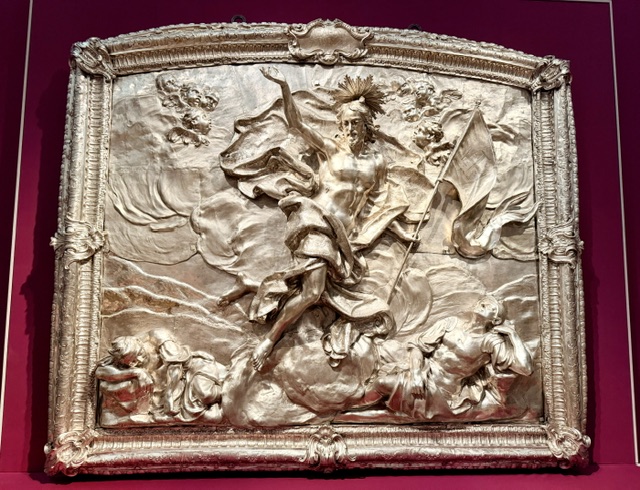
The Resurrection in silver, circa 1736.
The Resurrection in silver, circa 1736.
Source:
The Kimbell Opens The Holy Sepulcher: Treasures from the Terra Sancta Museum
Holy Sepulcher - Two Ceremonial Basins by Claude Caignet, Circa 1609.
Holy Sepulcher - Two Ceremonial Basins by Claude Caignet, Circa 1609.
Source:
The Kimbell Opens The Holy Sepulcher: Treasures from the Terra Sancta Museum
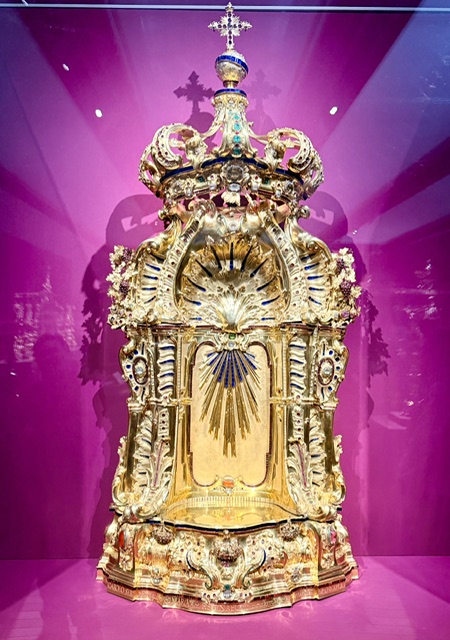
Throne of Eucharistic Exposition, of gold and gilt copper with precious and semi-precious stones, by Antonio De Laurentiis.
Throne of Eucharistic Exposition, of gold and gilt copper with precious and semi-precious stones, by Antonio De Laurentiis.
Source:
The Kimbell Opens The Holy Sepulcher: Treasures from the Terra Sancta Museum
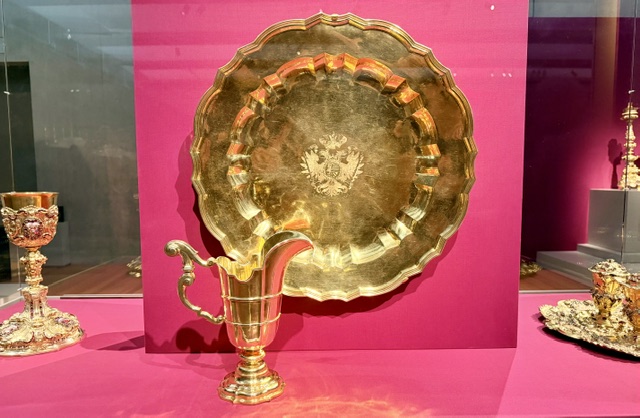
Ewer and Basin in gilt silver by Daniel L. Schaffler. Circa 1721-25.
Ewer and Basin in gilt silver by Daniel L. Schaffler. Circa 1721-25.
Source:
The Kimbell Art Museum has just opened its long-awaited exhibit, The Holy Sepulcher: Treasures from the Terra Sancta Museum, Jerusalem. For the first time, these artistic masterworks are making two stops in America. First at The Frick in New York and now at Fort Worth’s Kimbell. This rare glimpse into the treasures of The Holy Sepulcher will be on view from March 15 through June 28.
The Church of the Holy Sepulcher in Jerusalem is a mystical place. I have been there twice, and no trip to Jerusalem is complete without a visit to this holy site. It’s a bustling hive of activity, with throngs of visitors following in the footsteps of centuries of pilgrims. All of them cueing up to see the sight of the death, burial, and resurrection of Christ. But it is also a maze, just begging to be explored. Corridors filled with soaring painted and gilt ceilings, Crusader crosses carved into the stone walls, meandering hallways, and less-visited below-grade chapels.
It has been a pilgrimage ever since Saint Helena, the mother of Roman Emperor Constantine, traveled to Jerusalem in the fourth century to locate these sites and the “true cross.”
Treasures from the Terra Sancta Museum
Throne of Eucharistic Exposition, of gold and gilt copper with precious and semi-precious stones, by Antonio De Laurentiis.
The church of the Holy Sepulcher was constructed to preserve those religious sites under one roof. Its architecture flows from Byzantine to Baroque. Through the centuries, it has passed from Roman, to Christian, and Ottoman hands, but its treasures have been remarkably preserved.
“Including dazzling reliquaries, crosses, candlesticks, chalices, and vestments representing the height of seventeenth- and eighteenth-century craftsmanship, many of these objects have no equivalent anywhere else in the world,” according to The Kimbell.
The works chosen for The Holy Sepulcher: Treasures from the Terra Sancta Museum, Jerusalem date from the 16th to the 18th centuries, says Eric Lee, director of the Kimbell Art Museum. They were lavish gifts to the Church of the Holy Sepulcher, sent by Europe’s catholic rulers.
In fact, lavish is a bit of an understatement. This extraordinary exhibition showcases more than sixty objects in solid silver, gold, enamel, precious jewels, and vestments embellished with silver and gold thread and jaw-dropping embroidery.
Never Before Seen in America
The Resurrection in silver, circa 1736.
The Terra Sancta Museum will ultimately house all these precious artworks. It is currently under construction. Eric Lee says, “Every piece in the exhibit has never been seen before in America.” And once the Terra Sancta Museum is completed in Jerusalem, it is unlikely that the collection will travel far from its home.
This exhibition is traveling to only two venues in North America. The exhibition was first seen at The Frick Collection in New York before its second stop here in Fort Worth. It represents the first — and possibly only — time these treasures will be seen in the United States.
It was organized by Xavier F. Salomon, of The Frick Collection, with Benoît Constensoux and Jacques Charles-Gaffiot.
Rare Objects Survived in Jerusalem
Ewer and Basin in gilt silver by Daniel L. Schaffler. Circa 1721-25.
Xavier F. Salomon took the media on a preview tour on Thursday, March 12. He placed the objects in their historical context and explained why their survival is so incredibly rare.
“The metalwork in gold and silver and the preservation of these textiles are extraordinary survivals,” he says.
Earthquakes, tidal waves, wars, and revolutions on the European continent have wiped away many examples of this intricate artwork altogether. The gifts lavished on the Church of the Holy Sepulcher by Europe’s Catholic monarchs were shielded from all that turmoil, surviving intact.
They have been preserved over centuries by the Custodia Terrae Sanctae and have been in use on a regular basis. The chalices have been filled with wine, the robes have been worn in ceremonies, the candlestands and hanging oil lamps have been lit, and altar pieces have been used and maintained.
Salomon explained that since a trip to the Holy Land was not possible for these European monarchs, they sent their affection in tangible ways. And, the monarchs of France and Spain commissioned the finest artists and artisans of the day to outdo one another with their gifts. It was an attempt to cement their country’s Catholic connection to the Holy Sepulcher.
You can spot the French pieces, which are laden with the fleur-de-lis (lily) emblem ― related to the French crown. As for the Spanish monarchs, their gifts are noted by Spanish lions and castle motifs. Of course, monarchies in Portugal, Austria, and Italy added their gifts to the remarkable horde as well.
This is a once-in-a-lifetime opportunity to view them during the Kimbell’s exhibit. Spring is popping with new exhibits all over the museum district.